
Picture this:
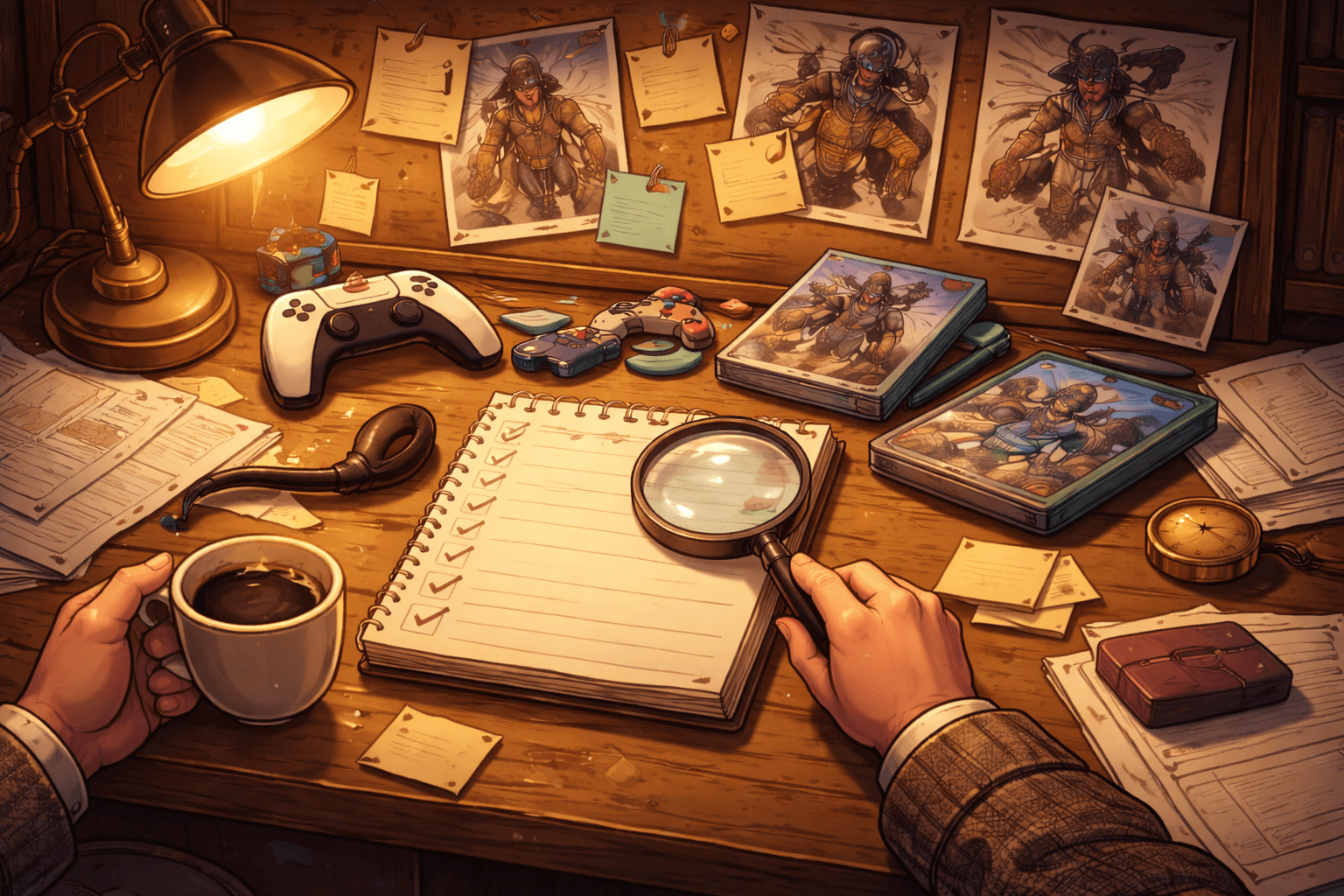
A quiet January night. Outside, the year is fresh. Inside, your game library is… a crime scene.
Dozens of titles, untouched. Others abandoned halfway through the story. DLCs lurking in the shadows. Rogue early-access survivors. And in the middle of it all: you.
We’re not just scrolling anymore, friend. We’re investigating.
So pull up a chair. I’ll be your slightly overdramatic detective—think Benoit Blanc meets Steam librarian—guiding you through the mystery of:
“Which games do I actually play this year… and which do I gently let go?”
No spreadsheets (yet), no guilt, and absolutely no “grind 5 hours a night” nonsense. Just a fun, story-like way to get your backlog under control.
Act I: The Crime Scene – Meeting Your Suspects
Every good mystery starts with the suspects in one room.
Open your library—Steam, PlayStation, Xbox, Switch, Epic, wherever. Scroll slowly. And instead of thinking “I should play that” about all 200, look at each game as if you’re seeing it in a line-up.
For every title, ask three questions:
Do I remember why I wanted this?
A friend’s recommendation? A genre you love? A wild sale at 2 a.m.?If I booted it up tonight, would I be excited… or just “meh”?
Roughly how long is it?
Not exact math—just: short (under 10h), medium (10–25h), long (25–50h), epic (50+).
That’s it. No charts yet. Just vibes and memory. You’re not judging yourself—you’re gathering evidence.
As you go, jot titles down in a simple note. Don’t sort them; don’t rank them. We’ll interrogate them later.
Act II: Motive – Why You Actually Want to Play
Now we dig deeper. A game doesn’t earn a spot in your New Year backlog just because it was on sale once. It needs a motive for being there.
Take a handful of games from your list—10 to start—and ask:
Is this comfort or challenge?
Something to relax with, or something that’ll ask for focus and effort?Is the pull emotional or social?
Do you want this for the story, or because your friends won’t stop talking about it?Is there a time window?
Live-service seasons, timed events, or communities that are very active right now?
Try to write one short sentence for each game:
“I want to finish this because I loved the first half.”
“Everyone I know is playing it online right now.”
“It’s been on my ‘must play’ list for years.”
Any game you can’t give a reason for? Put a tiny mental question mark on it. Those are the ones that tend to sit there, haunting you, without ever getting launched.
Act III: The Prime Suspects – Choosing Your “Case Files”
Every detective needs to focus. You can’t solve twelve cases at once—well, you can try, but it ends with cold coffee and a lot of unfinished business.
So for the next month or so, we’ll build a “Case File of Three”:
One Main Story Game
This is your headliner. The one you want to see credits on. Usually 10–40 hours.One Comfort Game
Your cozy sim, roguelite, chill racer, deckbuilder, farming, or puzzle game. The “I had a long day, I just want to unwind” option.One Social / Ongoing Game (optional)
Only if you genuinely enjoy playing with friends or keeping up with a live-service title.
Everything else? Still yours—just not under active investigation yet.
If picking feels impossible, use these tie-breakers:
Which game do you think about randomly during the day?
Which one would hurt a little if you never finished it?
Which one is your shortest route to a satisfying “I actually finished something” win?
Once selected, write them down somewhere visible. Not as a command, but as a promise to yourself: “These are the games I’m showing up for this month.”
Act IV: Time, Alibis, and Your Real Life
Now we examine your alibi: where does gaming actually fit in your week?
Forget the fantasy schedule where you finish three RPGs and a battle pass in twelve days. What did your real weeks look like lately?
Maybe you get 5–8 hours a week.
Maybe you play mostly on weekends.
Maybe you sneak in 30 minutes after work.
Whatever it is, that’s your backlog budget.
Think of it like this:
Main Story Game → 50–60% of your time
Comfort Game → 20–30%
Social Game → the rest, if you have one
If your main story game is 20 hours and you play 6 hours a week, you could beat it in about 3–4 weeks. That’s not a dream—that’s math with a trench coat on.
The beauty of seeing it this way? You stop thinking “I’ll never finish anything” and start thinking “If I keep this pace, I can finish X games this year.”
Act V: The Twist – Difficulty, Pride, and Stuck Spots
Just when the detective thinks the case is simple, a twist hits. In backlog land, that twist is usually a boss fight, a weird difficulty spike, or a stealth section that makes you want to uninstall your whole life.
This is where a lot of games die.
So before you even start, make yourself one quiet promise:
“If I hit a wall and stop having fun, I’m allowed to lower the difficulty, look up a guide, or cheese it.”
You’re not on trial. No jury. No platinum trophy jury of your peers. You’re allowed to:
Turn on accessibility options
Drop difficulty mid-game
Skip optional content that you don’t care about
Use a build guide so you stop stressing your skill tree
Finishing a good story is not less valid because you didn’t suffer for it.
Act VI: Backup – Bring in Your Backlog Buddies
No detective works completely alone. They have partners, informants, the odd chaotic ally.
Your backlog can use the same.
Invite a friend or two to start a mini “Game Club”:
You all pick the same game (or each pick one and just share progress).
You set soft checkpoints like “Finish Chapter 4 by next Sunday.”
You drop into chat once or twice a week with updates, memes, and mild peer pressure.
Suddenly, loading a game isn’t just “I should make progress.” It’s “I want to see what my friends think of this part.”
If your friends aren’t into it, that’s fine too. You can still use:
A private Discord channel
A simple notes app
A post-it on your monitor
…just to write: “This week’s case file: [Main Game] / [Comfort Game] / [Optional Social Game].”
It sounds silly, but seeing it clearly does half the work.
Act VII: The Red Herrings – Live-Service and FOMO
No mystery is complete without false leads and red herrings. In your gaming life, that’s live-service pressure:
Battle passes that expire
Limited-time skins
Seasonal events
10-page patch notes
These can quietly eat your entire schedule.
You don’t have to avoid them; you just treat them like side cases:
Pick one main online game to care about, two max.
Decide your limit upfront: “I’ll only play this 2–3 nights a week.”
If a pass requires way more hours than you can realistically give, be honest:
“I might not finish this pass, and that’s okay. My time isn’t infinite.”
Cosmetics will cycle. Seasonal events will return. Your time? That doesn’t respawn.
Finale: Closing the Case – Your Backlog, On Paper
Now we put everything together—no giant spreadsheet, just a clean little dossier that makes your year less chaotic.
Here’s a simple format you can copy into a note app:
Active Case File (Now)
Main Story Game:
Why it’s here:
Rough length:
“Finished” means: (credits / one route / up to Chapter X)
Comfort Game:
Why it’s here:
How you play it: (daily wind-down / weekend chill / podcast game)
Social / Ongoing Game (optional):
Who you play with:
Max nights per week:
On Deck (Later)
A short list of 5–10 games you might promote to Active when you finish something:
Title – why future-you might pick it
Title – why future-you might pick it
Cold Cases (No for Now)
Games you’re consciously not touching this year. Not because they’re bad, but because 2026-you deserves a cleaner slate than “55 half-hearted installs.”
You can always reopen a case. But for now, they’re closed with a stamp and a flourish.
Epilogue: The Year You Actually Finish Things
In the end, this isn’t about turning games into chores or your library into homework. It’s the opposite.
It’s about taking all that vague guilt—“I should play more of X, I never finished Y”—and turning it into a simple, human plan:
A handful of games you’re excited about.
A realistic sense of your time.
Permission to play how you like, not how the internet says you “should.”
Do that, and by this time next year, you won’t just have a pile of “games I own.”
You’ll have a neat little row of cases you’ve solved—stories you’ve seen through, worlds you’ve actually lived in, and a backlog that feels less like a crime scene and more like a library you chose on purpose.